
What ChatGPT Started
On November 30, 2022, OpenAI announced a research preview of its new conversational model, ChatGPT.1
Over the next 3.5 years, AI became a major topic of public interest, as illustrated by the chart below showing the relative frequency of queries for the term “AI” as reported by Google Trends.2
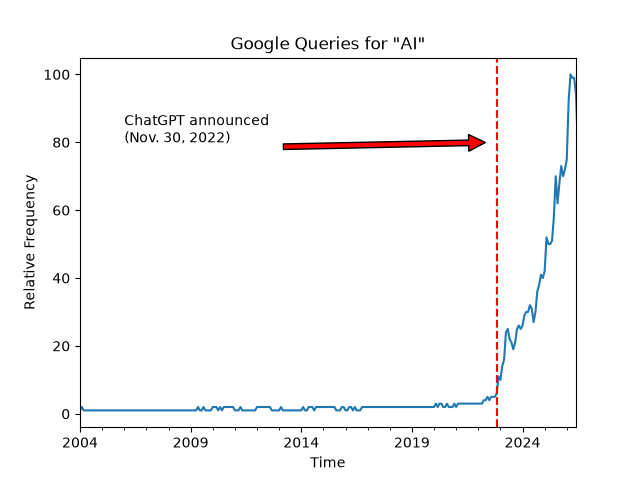
What the graph does not tell you is that the trend reflected not only greater awareness, but broadening public access to AI.
ChatGPT had a dialog interface. People could ask questions or make requests in plain English, and ChatGPT would quickly respond in English, making it accessible to millions of people. Unlike earlier models, which were typically specialized to one task, ChatGPT could answer questions on almost any topic, summarize or rewrite text, or even write new text given only a brief description. Moreover, the results were often comparable to what a person might produce given the same request.
For the first time in history, genies stepped out of stories and folklore and into the real world (or at least your web browser).
Of course there were issues. As in the stories, modern wish-makers often had trouble getting ChatGPT to do what they meant. ChatGPT (and similar models which followed it) might give incorrect answers or fabricate an answer rather than simply saying it didn’t know. When gauging the reliability of an answer, we often pay attention to hesitation or uncertainty, or meandering or inconsistent explanations. ChatGPT and similar large language models (LLMs) don’t give these cues. Finally, encouraged by these models’ broad knowledge, people started asking LLMs for advice on social situations, which call for wisdom rather than simple knowledge, or for financial or medical advice, where popular opinion is less reliable than expertise born of specialized training and long experience. I plan on talking more about these issues in future posts.
A Recipe for Genies
Where did these genies come from? While ChatGPT built on years of work by machine learning researchers, the key breakthrough was described in a paper from OpenAI entitled “Training language models to follow instructions with human feedback”, by Ouyang et al.3 It first appeared in preprint form in March 2022 and was later published in NIPS’22: Proceedings of the 36th International Conference on Neural Information Processing Systems. It described a three-phase training process:
- First, researchers started with a standard language model trained on raw, unlabeled text (a process known as unsupervised training).
- Next, they performed additional supervised training on examples of questions and requests and human-written responses.
- Finally, they optimized the model based on human preferences among alternative answers to a different set of questions, an example of Reinforcement Learning with Human Feedback (RLHF).
The authors described steps 2 and 3 together as a process of aligning output with user intent.
To evaluate the models, the researchers asked reviewers to rate responses on overall quality, as well as multiple specific criteria including instruction-following, appropriateness, hallucinations (making up information), harmfulness, toxic language, or bias. Comparing with GPT-3, a purely unsupervised model, they found improvements in most categories (though not in bias). However, the aligned model still exhibited hallucinations in 15 – 20% of responses.
ChatGPT is no longer unique in its ability to answer questions or write or transform text. Well known families of generative large language models include Claude (from Anthropic), Gemini (from Google), Llama (from Meta), Mistral and Mixtral (from Mistral AI), DeepSeek (from DeepSeek/HighFlyer), and Qwen (from Alibaba).
However, while there are multiple different techniques for the third step, and many other improvements to the models, the recipe above so far remains the only published way to build a genie. Given the success of these models, much of the research in AI in the last three and a half years has centered on this approach and the resulting models.
How This Changed AI (so far)
For the Public
Prior to ChatGPT, machine learning engineers knew how to train models for individual tasks. However, doing so required gathering and labeling thousands of examples. Some fraction of those examples would be held out, omitted from the training set used to build the model and at least initially hidden from the people building the model. A portion of the held-out set, known as a dev set, would be used to verify that the model was working and optimize its performance. The rest, would be reserved for an unbiased evaluation of the final model.
This had to be repeated for each new task, and most models were specialized to a single task. Given the time and effort, engineers usually developed such models only when there was repeated and ongoing need for the task, and only when demand exceeded the available human expertise.
ChatGPT upended the situation. Now, anyone could use AI even for one-off requests, such as customizing a message to a particular audience. If you make a request and the initial results aren’t satisfactory, you don’t necessarily need to retrain the model. Instead, you can point out the deficiencies and ask it to try again.
For Practitioners
What are the implications for the data scientists and machine learning engineers who built models the old way?
There are still problems to solve, such as:
- decisions depending on more information than one person can remember, or longer focus than most people can sustain, or
- tasks where the need exceeds the available human resources.
There is certainly a temptation to try an LLM first. After all, why collect and label data if you haven’t at least tried an LLM? What’s the harm?
In an upcoming post, I’ll talk about the worst case scenario – the Knowledge Trap – and how to avoid it with an evaluation-first approach.
Sources
- OpenAI. 2024. “Introducing ChatGPT.” March 13. https://openai.com/index/chatgpt/.
↩︎ - “Explore – Google Trends.” n.d. Accessed August 8, 2026. https://trends.google.com/explore?q=AI&date=all&geo=US. ↩︎
- Ouyang, Long, Jeff Wu, Xu Jiang, et al. 2022. “Training Language Models to Follow Instructions with Human Feedback.” arXiv.Org, March 4. https://arxiv.org/abs/2203.02155v1.
↩︎

Leave a Reply
You must be logged in to post a comment.